
Hard Block or Soft Warning for Overdue Gauges?
When an operator scans an overdue gauge, does the system stop them or warn them? Decide it by risk, write it down, and defend it at audit.
Hard Block or Soft Warning? Deciding What Happens When Someone Checks Out an Overdue Gauge
It is 05:40 on a Monday. The second-shift operator at the gauge crib scans an M10 thread plug gauge for the first-article check on a new lot. The calibration due date was Saturday. Nobody in the lab is in yet. The question is not whether the gauge is out of tolerance — it probably isn’t. The question is what the system does next: does it refuse the check-out, or does it show a warning and let the line run?
Most quality engineers have lived both versions of that morning. With a hard block, the line waits forty minutes for a supervisor, and by Wednesday someone has asked whether the block can be "loosened". With a soft warning, the line runs, the warning gets clicked through, and six weeks later an auditor finds three lots inspected with an instrument that was overdue at the time of use.
Both outcomes are defensible. Neither is defensible if the choice was never made deliberately. That is the point of this article: hard block versus soft warning is a risk decision, and it belongs on paper before it belongs in a setting.

What the standards actually require
ISO 9001 clause 7.1.5.2 requires that measuring equipment used to provide evidence of conformity be calibrated or verified at specified intervals, identified so its status can be determined, and safeguarded from adjustments and damage. It also requires the organisation to determine whether the validity of previous results was adversely affected when equipment is found unfit, and to take action. Nothing in the clause tells you how to stop an overdue gauge from being used. It requires that you control it.
IATF 16949 (7.1.5.2.1) and AS9100 (7.1.5.2, historically one of the most-cited AS9100 clauses) add record and recall expectations, but they still leave the control mechanism to you. ISO/IEC 17025 7.4 expects a lab to prevent unintended use of equipment that is not fit for purpose.
What has changed this year is the framing. ISO 10012:2026, the first revision of the measurement-management standard since 2003, moved to the harmonised structure and an explicitly risk-based approach. If your measurement management system follows it, "what happens to an overdue instrument" is no longer a software preference. It is a control whose strength should match the consequence of getting the measurement wrong.
The two controls, described honestly
A hard block prevents check-out of an instrument whose calibration due date has passed. The operator cannot take it without someone with authority intervening, and the instrument effectively goes to quarantine until it is calibrated or formally released.
A soft warning permits check-out but makes the overdue status unmissable and records that the user proceeded. The control is detective, not preventive: it relies on the record and on someone reviewing it.
The hard block’s failure mode is production pressure. When it is applied to instruments that don’t warrant it, people find workarounds — a borrowed gauge from the next cell, a measurement taken "by eye", a spare that was never registered. Those workarounds are worse than the overdue gauge, because they leave no trace at all.
The soft warning’s failure mode is habituation. A warning that appears on 15% of check-outs stops being read by the second week.
A worked risk assessment
Score each instrument family on three questions. Keep it simple enough that an auditor can follow your reasoning in two minutes.
- Consequence — if this instrument is out of tolerance and nobody knows, what escapes? A safety-critical joint, a customer-specified characteristic, or a non-critical feature caught later in the process?
- Detectability — would a downstream check catch the error before the part ships?
- Drift history — what does your own as-found data say? A family with roughly 95% of units found in tolerance at the end of the interval is behaving; one with repeated out-of-tolerance as-found results is not.
Applied to a typical machining and assembly plant:
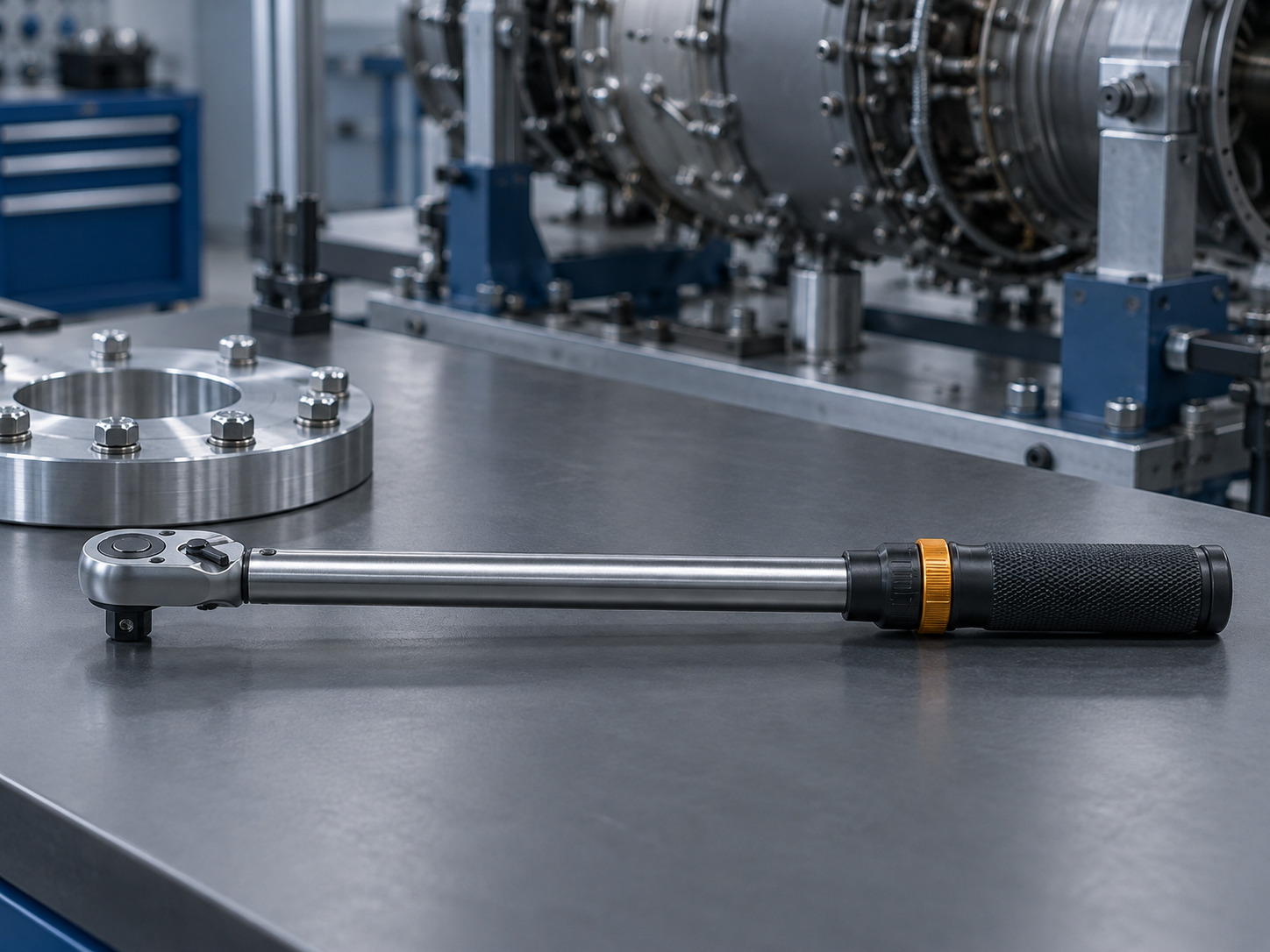
- Click torque wrenches on flight-critical or safety joints — high consequence, low detectability (a torqued joint does not reveal its torque afterwards), drift is real with use. Hard block, no exceptions.
- Thread plug gauges for customer-specified threads — medium-to-high consequence, moderate detectability at final inspection, low drift but wear-dependent. Hard block, with a documented emergency release path.
- Gauge blocks used as working references in the metrology room — consequence propagates into every instrument they verify, but they are handled by trained staff in a controlled environment. Hard block is cheap here, because the people using them are the people who can calibrate them.
- Shop-floor general-purpose instruments on non-critical features — low consequence, high detectability downstream. A soft warning is a reasonable, defensible choice, provided overdue use is reviewed.

The objection: "One setting can’t fit all of that"
It’s a fair objection, and it applies directly to how PrüfDesk works. Overdue blocking in PrüfDesk is configured per tenant — hard block or soft warning for the whole company tenant — not per instrument family.
That constraint is useful rather than limiting, because it forces the decision your auditor will ask about anyway: what is your default, and how do you handle the exceptions?
The defensible pattern is to set the tenant to the control your highest-risk family needs, then manage lower-risk families through procedure rather than through a looser default. If torque wrenches on safety joints need a hard block, the tenant runs on hard block. A plant with no safety-critical or customer-specified measurements may justify soft warning, and should write down why. What you should not do is pick soft warning because the hard block was inconvenient for low-risk gauges, and leave your high-risk instruments behind the same weak control.
The other half of the answer is that the control at check-out is only the last line. In PrüfDesk, due dates are auto-calculated from the last pass record and the calibration interval, so overdue status is never a manual judgement. Due and overdue lists let department managers see what is about to lapse before Monday morning. And when a soft warning is overridden, the check-out still lands in the possession audit trail — who had the instrument, when, and where — which is exactly what you need for the 7.1.5.2 "validity of previous results" assessment if the as-found result later comes back out of tolerance.
What to write down
A one-page decision record is enough. It should state:
- The tenant setting chosen (hard block or soft warning) and the date it was set
- The instrument families assessed, with consequence, detectability and drift scored
- Which family drove the choice, and why
- The emergency release path under a hard block: who may authorise it, and how it is recorded
- How overridden warnings are reviewed under a soft warning, and how often
- When the decision is reviewed — at least at management review, and after any out-of-tolerance escape
Attach it to your measurement management procedure. When the auditor asks why an overdue gauge could or could not be checked out, you hand over a page instead of an explanation.
Closing thought
The 05:40 scan will happen. The only choice is whether the response was decided calmly in advance or improvised by whoever was on shift. If you want to see how PrüfDesk’s overdue setting, due-date calculation and possession trail fit together on your own instrument list, a short walkthrough is the easiest way to check it against your risk assessment.